Loading

1.13.2020

Sandwich Bread

Sliceable bread that holds up for a hefty sandwich and freezes well also.  


Ingredients:
  • 4 T. almond flour
  • 0.25 c. flax seeds whole 
  • 8 T. coconut flour
  • 1 T. baking powder (gluten and aluminum free)
  • 1/2 t. pink salt
  • 8 large eggs
  • 1 T. organic butter 
  • 1/2 c. boiling water
Grind flax seed in blender or food processor.  Add almond and coconut flours, baking powder, and salt.  Boil the water and melt the butter.  Add the boiling water to the Vitamix (blender) while blending on low speed.  Add the butter and eggs.  Blend on high for 1-2 minutes until thoroughly mixed.  Bake for 30 minutes at 350 degrees or until top is springy to touch.  Let completely cool before slicing and serving

8.25.2019

Coconut flax bread

Gluten free, dairy free, grain free bread? I’m sure there are many more trendy labels for this humble loaf. Easy to make in the vitamix. Bring on the butter. Or coconut oil. Or guacamole. Sometimes all three. Who says I’m not ambitious?


Coconut flax bread:
 1/4 c whole organic flax seeds (I use brown)
 6 tablespoons organic coconut flour
 1 tsp pink salt
 1 tablespoon baking powder (I use bob red mill gluten free no aluminum)
 6 eggs, large
 2 tsp organic apple cider vinegar
 ~ 2/3 c boiling water

Spray oil on Pyrex. Preheat oven to 350 degrees. For this bread I use the vitamix.
Add the whole flaxseeds first and blend on high until ground (a few seconds). Add salt, baking powder, and coconut flour. Blend until mixed (a few seconds).  Crack eggs in a separate bowl and set aside (I skipped this once in a rush and ground eggshells into the bread. Crunchy. Yucky). Add boiling water and then vinegar while mixing on low. Then add eggs. Cover top and turn speed to high. Blend about 1 minute until completely mixed. Pour into Pyrex and bake 1 hour or until firm and bouncy to touch.  Sliced thin makes 15 slices.

Coconut flax bread. In all it’s half eaten glory

Tastes much better than my pictures look. I’m not into food photography and food porn. I like quick easy and healthy food.  As a note my mother in law has made this with two less eggs and added ground pumpkin seeds with great results.

1.10.2019

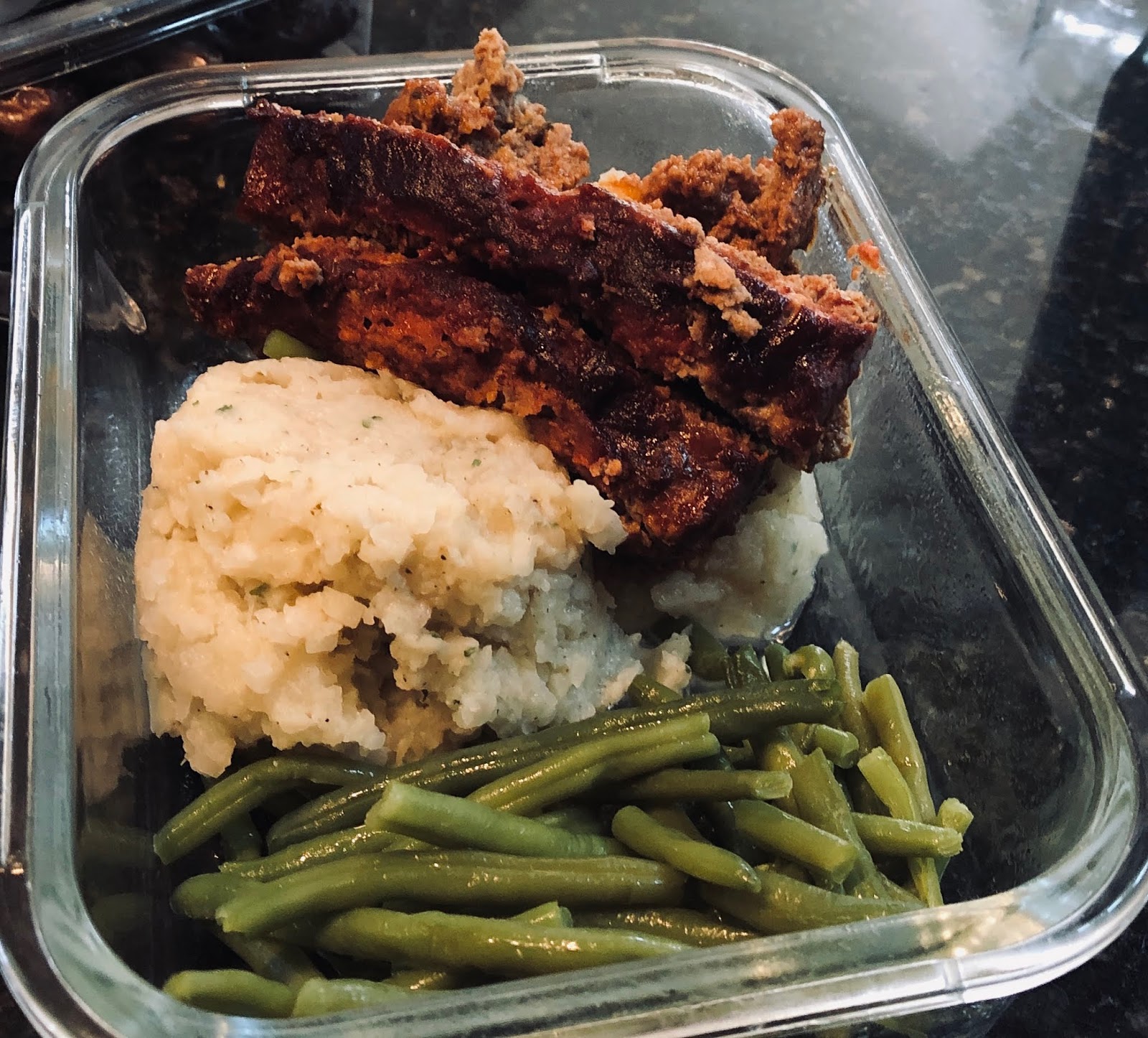
Organic Keto Meatloaf with mashed cauliflower and green beans

A comfort food meal on a chilly day the whole family will like. Well at least my picky boys (husband and toddler) like! A thank you to Mark Sisson at Marks Daily Apple for the base for this meal. We’re not all Keto, but we like variations on simple healthy food. The meatloaf uses my own version of tomato topping with stevia rather than ketchup or primal kitchen commercial sauces.


Meatloaf:
 2.5 lbs organic beef (85/15)
 3 eggs, large
 3 tablespoons organic coconut flour
 1.5 tablespoons Worcestershire sauce low sodium
 Pink salt, dash
 Black pepper, dash
 2 tsp garlic powder, 1 tsp onion powder
 1 tablespoon dried parsley, 1 tsp dried oregano

Topping:
 6 oz organic tomato paste
 ~1/2 c water
 1 tsp organic apple cider vinegar
Dried parsley dash
 4 packets organic stevia powder (I used NOW brand organic stevia)

Mix beef, Worcestershire sauce, eggs, coconut flour and spices. Mash until well blended. Press into oiled loaf pans or Pyrex. Mix tomato sauce topping until it is the consistency of ketchup. You can substitute organic ketchup or add blackstrap molasses or dates to your homade sauce. I only used stevia since I had extra packets on hand. Pour tomato sauce over meatloaf. Bake at 350 for 1.5-2 hours or until finished (our oven doesn’t work well so your cooking time may be much less than ours. Check after an hour). I cut thin slices so about 16 slices total.

Mashed cauliflower (my lazy way):
 10oz frozen organic riced cauliflower
 Pink salt and pepper to taste
 1 tablespoon organic butter
 Pinch dried parsley (or dried dill)
 ~ 2 tablespoons water to steam cauliflower (reserve liquid)
Makes 2 1/2 c servings

Steam cauliflower. Once very tender add butter (or buttery coconut oil if non dairy), salt, and pepper. Mash. I used the cooking water rather than cream or milk.

Greens beans are just steamed with olive oil.

I hope you enjoy. There are a lot of similar recipes out there. I don’t generally keep things like almond flour or specialty sauces on hand. Personally I’d just eat plain cooked beef and steamed cauliflower. The whole mashing and baking in shapes with sauces seems like too much effort to me. Food is fuel. But when feeding a toddler ....

1.10.2014

Turnip Green Soup

Frigid winter weather here up on our mountaintop hillside brings chills, ice, and cravings for some nice warm soup.  Of course me being me, I crave greens.  Already through my winter rotation of collards, kale, and mustards my body says "TURNIPS!" I mean it, in all capitals- seriously. 

It sure helps that the  turnip greens are packed with calcium and iron as well as many B vitamins and vitamin C.  Turnips themselves make lovely low carb options for soup, stews and puree dishes either replacing potatoes or used in conjunction with potatoes.  (Hence the common cauliflower or turnip switcharoo for mashed potatoes).

January being the new year resolution and diet bonanzzana that it is, low carb diets and primal type diets are all the rage.   I am not a fan of fad diets or even the notion of dieting.  Thus keeping with the "real food" mantra and eating what I have poking up between mounds of dirty snow and mulch, here's to turnips.  Ode to my mother as well for cooking greens for me (she loves kale now!) and calling my dad a "turnip head" (but not because he eats turnips).  

To me, bowl of green goodness.  To Jon, something rotting and wayy past its prime.


2 large turnips, washed
1 large bunch fresh turnip greens, washed and pat dry
2 jalapenos, seeded (optional)
2 slices nitrate free turkey (or pork if desired) bacon
1 cup dry white wine
1 cup water or gluten free chicken broth (homemade or I also use Kitchen Basics)
pink sea salt, to taste
fresh ground white pepper
Italian seasoning and parsley to taste
1 t. (gluten free) dijon mustard (Koops brand is gluten free)
2 T. virgin coconut oil (or bacon fat if desired)


This soup is a no brainer- start with not eating all the greens as you wash them (this is a clever tip I need to give myself often).  Wash and pat dry the greens and cut off the turnips and wash them.  I do not peel my turnips but peel away if you desire.  Start melting the coconut oil (or fat back) in a pot and place in the turkey bacon to brown.  Add the salt, pepper, and spices.

Wash and seed the jalapenos and set aside.  Chop the turnips into quarters or rough chunks.

Meanwhile, puree the greens in your Vitamix (or blender) with the water or stock.  Once the bacon is brown add the peppers and turnips and saute until the peppers are soft.  If you are short on time (or lazy like me) just add the wine to the peppers, bacon, and turnips and steam until the turnips are soft.  Be sure to cover the pot so you retain as much vitamin C as possible.  Once the vegetables are tender pour over the greens puree and add the dijon mustard and any other spices you want.  Let simmer until warm.  If you eat dairy I would recommend some raw cheese such as Beyond Organics's raw cheddar or your basic Parmesan cheese. Otherwise add a dollop of full fat coconut milk or creme fraiche to top the soup.   I ate it with a bow of fresh spinach, mushroom and raw apple ginger sauerkraut salad.  Now slurp away!

Notes: Jon thinks it has too much spice with 2 peppers (he's a wuss :)) and he says otherwise it tastes remarkably like split pea soup.  So there you go- a paleo low carb fake pea soup.  Exactly what I was thinking when I pureed turnip greens (sigh).  Sneak a bowl to your kids or spouse and see if they notice and comment below.


6.13.2013

Sprouted Curry Flax Crackers

Now that Paleo diets and Crossfit workouts are all the rage and soccer moms are packing kale chips in their kids' lunchboxes, it seems timely (or a bit late) to post a quick easy cracker alternative.  Flaxseed is a darling of the natural health circles and is yet another "health food" gone fashionable with the general public.  As a no net carb low carb seed packed with Omega 3 fatty acids and lignan fibers, it is easy to see why flaxseed is a popular ingredient.  


While there is controversy always raging in the Paleolithic community about exactly which food is paleo or primal, flax is considered a paleo hunter-gatherer diet friendly food and flour substitute.  While I love flax mostly for the beautiful blooms of the plant in my wildflower hedges, eating the seeds formed into crackers is enjoyable as well.  Soaking these innocent looking brown and gold babies allows them to sprout making the lignans and nutrients more bioavailable and enzymatically alive.  Rinsing the sprouted seeds before making the crackers removes much of the antinutrients like phytic acid found in nuts, seeds, and legumes.  Flaxseed makes a delicious versatile cracker spiced to your preference and convenient for travel and as a low carb "bread" or cracker replacement.  As always, consume in balance with healthy low glycemic foods and with plenty of water for the optimal benefit!  

ingredients:
2 cups organic (gluten free) flaxseed
about 2 cups filtered water
generous 1 T. raw pink Himalayan sea salt (used only salt not typical tamari or Bragg's liquid amino and salt blend)
 spices to taste: for the curry blend I used about

  •  2 T crushed red pepper
  • gluten free curry blend- I like the Madras style spicy curry turmeric 1 tsp
  • dried oregano

method:

First measure out and sort your flaxseed.  Add the filtered water (I use reverse osmosis water if that matters) and cover.  Let sit at least overnight until the seeds have sprouted.


The sprouting process will make the seed enzymatically active and more bioavailable and thus more easily digested.  The soaked mixture will be a gelatin like sticky goo.  To remove at least some phytic acid, rinse thoroughly with filtered water.  Just do your best, there are no hard and fast rules here.  The final rinsed mix should be gooey but not runny.

Add your sea salt and spices to taste.  Stir well.  It is helpful to spray your dehydrator or pan with nonstick spray or grease lightly with coconut oil at this point.  I use my old dehydrator with craft quilting mats I cut to fit (so the flax doesn't fall through the large dehydrator holes).


Spread the flax on the sheets about 1/8th to 1/4 inch thick.  You want the final product to be hearty enough to hold up to guacamole dip or shredded chicken, say, but thin enough to dry evenly.


You can also use a cookie pan and your oven.  If using an oven, dry around 100 to 125 degrees for about 6 hours.  I dry my chips in the dehydrator overnight until they break apart easily and are crispy.

sidenotes:
In the past few years flaxseed has gotten some bad press about its phytoestrogens and link with prostate cancer.  Is flax some insidious estrogenic food for men (or women for that matter who suffer from estrogen dominance and many hormone imbalance issues, especially after menopause)?  The Mayo clinic gives a short Q&A about this, but suffice to say that eating flax crackers in a balanced diet is not going to pump your body full of evil cancer-promoting cooties.  Taking high doses of flax oil for its ALA vegetarian omega 3 benefits, as once recommended, is probably not the best approach however since the oil is much more concentrated in phytoestrogens and lignans than the edible quantity of seeds.  I don't think Grok had access to high doses of isolated flax oil... somehow I doubt that Grok would drool at the sight of beautiful flax wildflower blooms as he might with a buffalo.   Besides, omega 3 fatty acids are best consumed as part of a whole food and from animal sources (read: eat fatty wild fish).   Lastly, there is evidence that the lignans in flax actually bind to estrogen in the digestive track.  For an interesting discussion on phytic acid and other antinutrient concerns in nuts and seeds, check out Mark's Daily apple.  I emphasize the importance of balance here as to not become overwhelmed by the micronutrient aspect of your food (didn't your mother tell you not to play with your food?!?).   Flax is healthy and fine in moderation- you wouldn't stop eating broccoli because of its phytoestrogen nuances would you?  Crunch on a darn flax cracker rather than a gluten carb rancid omega 6 oil GMO loaded chip, that's all I'm saying.  That and more importantly address your stress and lifestyle (exercise, sleep, diet, social support structure, higher power, etc) in a holistic manner, not just your food.  

On the lighter side, flax reduces inflammation, supports cardiovascular health, helps lower cholesterol, and reduces metabolic syndrome.  (Again, whether low cholesterol is actually beneficial to health is debatable and research shows that higher cholesterol in post menopausal women increases longevity).  

Flax ranks higher than blueberries and spinach in antioxidants and new investigation shows the delicate ALA omega 3 fats are not damaged by baking with flaxseed (and certainly not damaged by low temperature dehydration like here).  

The fiber in flax stabilizes blood sugar levels making flaxseed based crackers, muffins and breads better choices for those  with metabolic syndrome or on a low carb diet.  (Ground flax, hemp powder, and coconut flours make a wonderful hearty low carb high fiber gluten free and vegan "flour" blend.  I make variations of these baked goods and my digestion loves me for it!).   Flaxseed is high in manganese, magnesium, vitamin B1, and tryptophan to name a few nutrients.  Soaking and sprouting the seeds makes the crackers' enzymes and nutrients more bioavailable while the low temperature drying of the cracker makes it a raw food.  Of course the most touted glory of flaxseed is that it is practically all fiber so any food made of flax will be "no net carbs" which is what makes flax based muffins and bread popular in the low carb community


The longwinded micronutrient aspects of flaxseed aside, these babies are high fiber no net carbs spicy goodness and make great crackers for my hen's free range eggs from the backyard which I softboil and serve over steamed veggies and greens.  Get creative with your own spice blend- I have made these in various ways but always love a crunchy spicy treat!

Cindalou's Kitchen Blues: Healthy Celiac / Coeliac Gluten and Dairy Free Recipes

12.31.2012

Turnip chips

New Years brings new resolutions. Since I'm not one for resolutions, here I stand truckin' on in my same old Grok-ette style, but if you'd like to join me for some Paleo low carb munchie chips then crunch on!  Many thanks to BJ for gifting me with these fresh delicious turnips this past weekend.

I'd never pulled fresh turnips before.  Even on that chilly Sunday morning after viewing her hens and coop setup (yes, all us chicken mommies check out everyone else's coops), we sunk into the sandy mud to pull some gorgeous purple head turnips.  Since I pulled too many (darn efficient harvest hand) some turnip chips sounded good (again, thanks BJ!).  Easy, crunchy and seasoned to your pleasure...  For those embarking upon a low carb diet this new year, keep turnips in the forefront of your mind.  Though most root vegetables are high carb, turnips, celeraic root and cauliflower are great potato substitutes.


 About 1 lb fresh turnips
if desired: sea salt and seasonings of choice: for savory try parsley garlic powder and tamari or cayenne sea salt and curry.  Just plain old extra virgin olive oil, pink salt, and pepper work just fine too though!  

For raw turnips chips: wash and chop off ends.  My hens loved the fresh greens but you can eat them, make turnip green "chips" or discard them- whichever.  Slice very thin and place in dehydrator.  Rotate trays and check about every 4 hours.  I let mine dry overnight since it is chilly in our house.  They are finished when they are crisp.  Store in an airtight container.


Typical vegetable chip method for the dehydrator:
Wash and destem turnips.  Slice very thin and place in boiling water.  Blanch turnip slices; that is, boil for about 2 minutes until purple color is vibrant.  Drain and steep slices in ice water.  Drain again once cool and pat dry.  Salt and season as desired.  Place in dehydrator and dry in 4 hour intervals, checking slices to desired crispness.  Store in an airtight container.

Turnips are relatively low carb with raw turnips being a great source of certain B vitamins like B6 and folate, calcium, and minerals like copper and potassium.  Every bit of natural whole food vitamin source of potassium in particular will help to balance the SAD (standard american diet) bad sodium (processed salt) intake.  Cooked turnips will have more fiber but lose vitamin C and B vitamins if you drain the water.  Luckily blanching retains most of the vitamins so here this is not much of a worry.  Now grab your turnip chips and munch on into the new year!

crunchy turnip glory!

Cindalou's Kitchen Blues: Healthy Celiac / Coeliac Gluten and Dairy Free Recipes

9.13.2012

Breathe Easy Herbal Sea Salt Bath Scrub

After a hot day in the yard covered with god knows what (undoubtedly some array of grass trimmings, compost and chicken "charms," and good ole sweat) what I really want is a nice soothing bath.  Preferably one that helps me breathe and eases the contact dermatitis I keep getting from that darn poke weed... or poison ivy, not sure.   Anyways those who know me can vouch for my bath and herbal smelly products habit.  

Herbal scrubs made correctly with good ingredients and essential  oils are incredibly healing, though beware that most commercial scrubs use petroleum based oils (Bath and Body Works for one) and other non desirable chemicals.  More ranting on that later- suffice it to say an herbal bath junkie wants affordable   aromatic and quality scrubs.  I am a big fan of Sunshine scrubs which I order online (no I am not an affiliate, I just like their ingredients), however my bath scrub and essential oil buying habit was starting to plunder the piggybank.  Thus I now make my own and it's so easy and fun anyone can do it (mental glimpses of sundry Geiko commercials here).  

To make a pint wide mouth mason jar of scrub:
wide mouth mason jar with lid
scoop
sea salt, coarse ground for maximal exfoliation or fine ground for more sensitive skin
extra virgin olive oil*
~1/4 c virgin coconut oil, melted (optional- you can use all olive oil if desired)
~1.5 T. cut and dried sage leaf (I used some from my garden)
1 T. dried orange peel granules
1 T. brown sugar (optional)
to smell and preference: essential oils of Eucalyptus, orange, and grapefruit 

*often sweet almond oil, sunflower, safflower and other oils are used as carriers (bases) but I used olive oil since it is cheap and almost everyone has it on hand. 

just add water and skin!

In your glass jar melt the coconut oil and add one part oil to two parts mix of sugar and salt. Add the amount of salt/sugar you desire for the "scrub" feel- anywhere from a few tablespoons to a cup.  Add half that amount of oil, the orange peel (just for more "grit" and orange essence), sage, and essential oils. Mix with a spoon.   That's it! Cancer promoting estrogenic free holistic scrub to soothe your body and soul for cheap!


The Romans called sage "herba sacra" and its namesake "salvation" attests to its healing powers.  Sage is useful for skin and oral infections, irritations, can help boost mood and even ease mild depression.  Sage also effectively reduces fatigue without the edginess of a stimulant.  For you Ayurvedic folks out there, it helps balance the pelvic chakra and for us common folk it supports the metabolism.  Sage is antifungal, slightly phytoestrogenic, and antitumorial and is often used to balance the hormones.  

Orange essential oil is a common blending oil and like most of the citrus family oils is composed of 80% to 96% limonene.  The high limonene content contributes the antiturmoral aspect of orange oil, though it is more commonly know for its uplifting, relaxant, and circulatory stimulant qualities.  Orange oil aids with muscle spasms and is a useful tool for both sore muscles and irritable bowel syndrome or dyspepsia.  Citrus oils also contain potent bioflavonoids such as Vitamin P.  Dr. David Jockers recently blogged about a few essential oils for ingestion and skincare, as can be read in his newsletter.


Eucalyptus essential oil contains concentrated eucalyptol and is know for its antimicrobial action in mouth washes like Lysterine, though it is also used in chest vapor rubs and toothpastes due to its expectorant and mucolytic qualities (a potent decongestant).  Eucalyptus oil is antibacterial, antifungal, and antivirual properties to boot.  I know I can finally get a good chest full of air taking a steep in it after a day in the yard.  

Grapefruit seems to be the hot item in beauty products currently with brands like Neutrogena pushing their pink grapefruit facial products for grapefruit's antiseptic and detoxifying aspects.   But thsi ruby gem is not just another delicious (and low glycemic) fruit treat, grapefruit oil itself boasts all the purported metabolism and cleansing actions of the fruit while also acting as a mild antidepressant.  In fact the oils of the whole citrus family are largely composed of limonene which gives grapefruit, lime, orange and bergamot cleansing and uplifting essences.  

Last but not least is coconut oil which is righly nourishing to the skin as well as internal organs.  It is antiviral  antifungal, antibacterial, and high in vitamin E.  The MCTs (medium chain triglycerides) lauric acid, caprilic acid  and myristic acid among a few of the components of coconut oil which contribute the antimicrobial qualities of the oil.  Don't worry about feeling "greasy" when using coconut oil on the skin- simply rub in and if desired rinse off 10 or so minutes later to leave your skin soft and supple.  The skin being our largest body organ and membrane is quite permeable and absorbs any products which we apply.  Since coconut oil is a whole food and free of tany man-made chemicals you can have your scrub and eat it too!

Cindalou's Kitchen Blues: Healthy Celiac / Coeliac Gluten and Dairy Free Recipes

6.23.2012

Herbed Heirloom Tomato Salad with Red Kraut


Grok's been out in the garden as of late.  Summer solstice brought forth a crop of fresh assorted tomatoes, beans, greens, and all sorts of colorful goodies (man I love gardening in old chicken runs! Great poop dirt :))  I love combining my homemade red sauerkraut with fresh produce, especially our various tomatoes.  This is quick, easy and an excellent side dish or snack with avocado (what isn't great with avocado though?!?).  Don't waste these beautiful days inside slaving over a hot oven and instead sweat outside in your garden!

1 large fresh red tomato (I used a better boy I think)
1 large yellow tomato (I used a yellow jubilee)
1 clove fresh garlic, minced
1/4 c. homemade or raw unpasturized red sauerkraut
2 T. organic raw apple cider vinegar
2 T. extra virgin olive oil
1 T. dried (homegrown) oregano
1 tsp. dried dill weed
1 tsp. stevia (optional)
sea salt and pepper, to taste 


Easy: Chop tomatoes into bite sized pieces, combine vinegar and olive oil with garlic and herbs and toss.  Spoon over red kraut and mix gently.  Chill and serve with fresh sliced avocado.


Fresh tomatoes are wonderfully hydrating and a great natural sugar pick me up on a dehydrating summer afternoon.  Since lycopene is concentrated in tomatoes cooked in oil, adding avocado and olive oil will help nutrient absorption.  The oregano adds a nice bite, especially if it is fresh.  I used some I dried from my garden a few weeks ago and it is quite pungent, medicinal even.  Oregano itself is a famous medicinal food (think Hypocrites' commandant) which is high in anxtioxidants, vitamin B6, folate, and assorted minerals like potassium and copper.  It is also nicely balanced in calcium,  magnesium, and iron.  These minerals which compete for absorption in the body but are balanced when found in nature for better bio-availability.  Since oregano is a good source of fat soluble vitamins A, E, and K be sure to consume it in dishes with healthy fats such as extra virgin olive oil and avocado or guacamole.  Raw nuts and virgin coconut oil are also great fats, but try to avoid peanuts and cashews which are legumes, not nuts (at least if you're Paleo).  Oregano is also a highly antiinflammatory and a great antibacterial, antiparastic, and antibiotic herb.

The red sauerkraut is a fantastic Paleo/ low carb condiment which whacks a nutritional punch beyond its volume.  I make my own krauts and kimchis and prefer red kraut to regular green since it adds such color.  Red cabbage also provides a different array of nutrients and phytochemicals than the other varieties of cabbage.  WHFoods cites red cabbage as higher in anthocyanin polyphenols and vitamin C.  Mother was right: Color is the key to health!

As I've mentioned previously, raw lacto fermented foods like sauerkraut provide a concentrated source of probiotics with additional strains such as L. Plantarum which stick to intestinal walls and are not found in other fermented foods.  As a note, you must get raw and unpasteurized saurerkrauts, not the commercial bagged or canned sauerkrauts which are pasteurized.  The high temperatures of canned products kill all the bacteria, good and potentially bad. So spoon on the krauts swimming in friendly intestinal goodies and eat up!

4.18.2012

Paleo Pumpkin Spinach Curry (Chowder)


How about a quick and simple (Duh, Grok can do it) nourishing Paleo low carb soup? Yum.  It's an authentic EBTKS (everything but the kitchen sink... though I would have added it too probably if I could have unlodged it from the counter... disturbing but predictably Cindalou).  Feel free to use this as a template to get creative yourself- perhaps some turkey or buffalo sausages or shredded chicken? Or heck, a nice grass fed beef patty would do beautifully here with the curried pumpkin spinach base.  Anyways those are future pot creations I might do (it depends on what falls out of our freezer when I open the door). Gotta put that heavy stuff lower in the freezer soon (enter throbbing toe)...


 Throw in the pot:
  • 1/2 c. organic plain (unsweetened) pumpkin (canned)
  • 4 c. raw spinach (add near end)
  • 3 softboiled eggs, divided
  • 1 T. evoo
  • 1 c. organic chicken broth/stock (I use homemade or gluten free versions like Kitchen Basics aseptic broth) 
  • 1 small (each) red and yellow bell pepper 
  • 1/4 c. whole tomatoes, smashed (I used canned)
  • 1 small perch fillet (about 1-2 oz., its what I had on hand and cooks quickly)
  • curry powder, cayenne, fresh pepper and sea salt to taste (I like a lot)
  • guacamole (topping)
First I simmered the broth, pumpkin, spices, tomatoes, and bell peppers until the peppers were soft.  In the meantime I scooped out the softboiled yolks of some of our hens' eggs (talk about fresh- I watched an Americana plop one down.  She squatted and looked rather toliet bound if you know what I mean, very funny to watch!).  Why softboiled? I can't eat cooked egg yolks (elmer's glue anyone?).  I either take my yolks runny, soft or straight up raw.  I never get sick from it either.  As a note I can vouch 100% for the health and sanitary conditions of our eggs.
  
I add the egg whites to the soup and reserved the yolks so they do not get overcooked.  The more raw your yolk the better from a nutritional standpoint.  As with many foods cooking either destroys or inactivates many vitamins (B's in particular here) and components.

Then I added the perch and spinach, turning the heat to high.  I let the soup come to a rolling boil for about 3-5 minutes until the fish was finished (flakes easily with a fork. Like a bad case of dandruff or superficial people).  Pour the soup in your bowl and add the yolks and olive oil.  Top with guacamole and fresh pepper.  Yum (and quick)!


4.10.2012

Simple Brown Rice Pancake Snackers [Low Carb][Vegetarian]

Well they're not green (what a shame!) but as per phone request for baked gluten free coconut flour 'stuffs', I thought I'd whip up some simple and quick higher protein pancakes.  I also hate random products laying around and I was trying to think of what to do with this rice protein I have in the pantry since I haven't used the stuff in ages (cause it's not green as Jon would say).   The verdict was to cook up something which was edible or feed it to the chickens.... so we have pancake snackers! 

 Of course since I don't usually eat nor do I even like bready foods, these are mostly for snacking on when I get home late from art class- or whenever.  They must meet my requirements of a) using something coconut and b) be low glycemic.  Not my usual style, but hey this loose 'recipe' should be sufficient to get ya'll out there making baking recipe phone requests started.  

Brown rice protein is a very clean protein nonallergenic which is highly bioavailable (well for plant based aminos).  I do always have philosophical musings on any protein since any isolated substance probably isn't good for you in the long run.  At least Grog didn't find canisters of powders hanging out in the fields with the bison.... 
These aren't Paleo but they do fit the low carb and low glycemic vegetarian profile for those of you out there.  I usually use hemp powder or straight coconut flour for pancakes but I thought this would have more mass appeal (the hemp makes nice green brownish pancakes which make even worse pictures believe it or not!).

Brown Rice Protein Pancakes

Serving size: 8 small pancakes or 2 servings
 
Thanks girls! (That's to our hens- the green one is probably from Blackbeard, one of our Americanas)
 
Brown Rice Protein, Jarrow brand 1 heaping Tbsp 2.0 x Custom Food (15g)
Egg, whole, raw, fresh 4.0 x 1 small (38g) (courtesy of our hens)
Leavening agents, gluten free baking powder 2.0 x 1 tsp (4g)
Salt, table 1.0 x 1 dash (0g)
wilderness naturals coconut flour 1 T.
water~2 oz or enough to hydrate batter (remember coconut flour absorbs a lot of liquid!)
stevia glycerite liquid to taste.  I used a hefty drizzle but it is optional
spices: 
cinnamon about 1 tsp
cayenne, dash
turmeric, dash
 
Prep:
Crack and beat the eggs in a small bowl.  Heat frypan and melt in coconut oil for frying.  Mix all ingredients well.  Feel free to add some great low carb berries (blueberry, cranberry, etc) or even some nice steamed spinach (mmm.. there I go thinking green again).  Fry about 2 minutes per side and flip when bubbles appear on edges. 
 

They turn out great- nice and fluffy which was surprising since I improvised the whole 'recipe' this morning wandering around with low blood sugar. I'm looking forward to snacking on them when I get home tonight, well if there are any left.

Rough nutritional info, courtesy Nutrition Data.com

Next pancake or muffin post will be one of my staple (and paleo friendly) hemp and/or coconut creations.  Until then sprinkle on some Himalayan pink salt (mmm, better topping than nasty syrup or HFCS "syrups" for sure!) and munch.

1.19.2012

Kimchi (Napa Cabbage and Bok Choy) and Fermented Radish & Kale [Paleo][Low Carb]

Kimchi is a traditional Korean dish of spicy fermented cabbage. Napa cabbage, usually. An excellent example of the power of the wisdom in traditional diets, kimchi combines the "superfood" elements of cabbage with those of onion and cayenne. As I have mentioned previously,

Cabbage:
  • protects against a wide spectrum of cancers
  • is a great source of glutamine
  • is healing to the digestive system
  • has a mild cholesterol lowering effect*
  • provides antioxidants
  • is a good source of vitamins A, C and K, and anti-inflammatory polyphenols.
The George Mateljan Foundation has an in-depth summary of the health benefits of cabbage and kale. A particular cabbage glucosinolate, sinigrin, has been the focus of anticancer research. In addition,

Kimchi:
  • provides additional detoxification benefits due to the high sulfur content of onions and garlic
  • boosts metabolism (cayenne)
  • provides more vitamin A and C (cayenne)
  • helps lower cholesterol* (cayenne)
Fermented foods like kimchi are a great source of "good" gut bacteria. When made properly with salt or whey (lactofermentation), kimchi and sauerkraut provide an especially important and less common bacterial strain, L. Plantarum. It is one of the few flora strains which sticks to the intestinal wall rather than being processed out by the body like other strains of "good" bacteria. Lactic acid produced in traditional fermentation is one of the most valuable organic acids since it can be used in the body more immediately than other important fermentation by-products like acetic acid.

My kimchi is based on Dr. Ben Kim's recipe. Dr. Ben Kim, from whom I adapted this basic recipe, focuses on the use of Napa cabbage and gives a great pictorial step by step method of traditional kimchi. As anyone who knows me can vouch, however, I cannot follow a simple recipe and have thus fermented a few other varieties of my own "kimchi" using kale and bok choy. Who can pass up such vibrant vegetables in the produce section? Certainly not me, though it would be better if they were growing out of my garden...


Ingredients for the Napa Cabbage Kim Chi: (substitute Bok Choy for Napa cabbage below for the Bok Choy version)
  • 1 large Napa cabbage
  • 1 bunch fresh scallions
  • onion, yellow chopped
  • garlic, minced. I used about 5 cloves
  • 1-2 T. salt (use the second T. salt if not using whey)
  • 1 T. cayenne powder
  • ~1/4" chunk fresh ginger root
  • 1 organic green apple (to puree) or applesauce, unsweetened
  • optional: 2-3 T. sea vegetable flakes

Ingredients for the Fermented Kale and Radish 'Kim Chi':
  • 1 large crisp bunch kale
  • ~ 5 radish
  • onion, yellow chopped
  • garlic, minced. I used about 5 cloves
  • 1-2 T. salt (use the second T. salt if not using whey)
  • 1 T. cayenne powder
  • ~1/4" chunk fresh ginger root
  • organic green apple (to puree) or applesauce, unsweetened
Procedure:
  1. Chop up the Napa cabbage, bok choy, and kale into bite sized pieces. Place in separate bowls. Note: Dr. Kim states that the brassicas shrink about a quarter in fermentation so the end product will have smaller pieces than it initially seems.

    Chopped raw Napa cabbage (L), kale (C), and bok choy (R)

  2. Thinly slice 4 oz. of the radish and either chop or slice the onion. Measure out or pinch desired amount of kelp or other sea vegetable. Set aside.
  3. Measure out 1/4 c. sea salt.* I used Celtic sea salt but really all you need is a basic pure salt and preferably without fillers which will cloud the final fermented product. The Celtic sea salt is a great source of trace minerals and is unrefined. It is not processed with chemicals or at high heat which can damage the healing properties of the salt as many commercial salts are. This brand in particular is "doctor recommended" if that is important to you. *Note: Salt such as Celtic sea salt or table salt with with iodine will slow fermentation. Use pickling salt (iodine free canning salt) if you would like a shorter 2-4 day room temperature fermentation. (Thanks Ima for clarifying that!)
  4. Dissolve the sea salt into warm water and then add the brine to the cabbage batches. Mix the brine and cabbages. I wore gloves so the salt wouldn't sting however the salt is very healing for the skin and will naturally exfoliate and gently detoxify the skin with its astringent quality.

    Salting the cabbage

  5. Cover the salted cabbage batches and let sit at room temperature for about four hours. If it is significantly cooler in your kitchen then you can let it sit a bit longer.
  6. After 4 hours, rinse squeeze dry.

    After 4 hours of salting: Napa cabbage, Kale, and Bok Choy. Rinse well and squeeze dry (far right)

  7. Measure out 1/4 c. cayenne powder or red chili flakes/powder. Mix with warm water to make a paste.

    Make the cayenne paste

  8. Mince and/or sliver fresh garlic and ginger. Measure out your T. garlic and ginger (I used a hefty scoop of organic bottled ginger and slivered some of my garlic and minced the rest in the Vitamix later).
  9. Slice the green onions. I do so at an angle for visual appeal.

    Prep the ginger and scallions.

  10. Puree a few Vitamin C tablets (not necessary but they keep the mix from browning. Lemon juice could also be used I suppose), the cored organic granny smith apples, about 2/3 of the onion, and the remaining 4 oz. of radishes in the Vitamix with 1/2 c. water to make a natural sugar substitute for the cabbage to use as food for fermentation. Note: Dr. Kim's recipe uses apple, pear, and onion but I didn't have pears plus I wanted to add radish and my own twists (read: I can't follow a recipe to save my life, ha!). This puree is the replacement for white sugar, the fermentation food in commercial kim chi and fermented vegetable varieties.

    Slice the radish and onion. Puree the apples, remaining radish, garlic (if not minced), and onion with water and Vitamin C for fermentation sugar base.

  11. Add the kelp (sea veggie)*, sliced scallions, onion, cayenne/ginger/garlic paste to the kimchi base (the rinsed brined cabbage). Add about 1/3 of the apple puree, the green onions, and the red chili paste and ginger to each of the cabbage batches. You will have to make a full red chili paste batch as in step 7 for each cabbage batch (one for Nappa, one for bok choy, and another batch for the kale). *Again note that the high mineral (iodine) content of the sea vegetable will slow fermentation a bit.
  12. Mix well with gloves.
  13. Using a wide mouth funnel (such as a canning funnel made for Mason jars), spoon the kimchi into sanitized glass jars. Leave some head space (a little room) at the top for expansion as the brined mixture ferments. Leave the jars out at room temperature for at least 24 hours before refrigerating. I actually leave my fermented vegetables out longer than this personally, but for spoilage sake I would recommend 24 hours if you are inexperienced. Otherwise if you are wise in the ways of the age old tradition of fermentation use your best judgement.
  14. Enjoy it! The refrigeration process slows the fermentation, though the batch will slowly continue to cure and become more sour with time.

Kelp and Sea vegetables are high in healing polysaccharides (long chain sugars) and nutritious whole foods.

Kelp and Sea vegetable benefits include:

  • thyroid support through bioavailable trace minerals (most notably iron and iodine)
  • high antioxidants
  • natural cholesterol lowering effects*
  • vandium, an essential component in nutritional support for diabetics/pre-diabetics which helps to regulate blood sugar
  • fucoidan polysaccharides. Anti-inflammatory, antivirual, and high in sulfur like the raw garlic and onions added to the kimchi. David Wolfe's new video on polysaccharides discusses how certain polysaccharides protect against strains of the herpes virus.
*Much research supports the fact that low cholesterol is not a preventative measure for heart disease. For women, the higher the cholesterol the better since the cholesterol-hormone interaction and blood sugar versus fat is more prominent in women (especially post menopausal women) than men. The Weston Price foundation has many research articles on the benefits of high cholesterol including how high cholesterol increases longevity.

Though kimchi is a delicious superfood, don't overdo it on cruciferous vegetables (cabbages, kale, collards, broccoli, etc) since they can slow the thyroid if overeaten. Raw and fermented cabbage contains goitrogens which block thyroid hormone production. The natural iodine and minerals in the sea salt and sea vegetable will help to balance the goitrogen effects, however fermentation actually activates the goitrogens. The Weston Price foundation says the following on fermentation and the "dangers" of goitrogens in crucifers:
Fermentation of sauerkraut actually activates the goitrogens from their precursors. It also has the beneficial effect of reducing the nitrile content to half of what would be generated by cabbage upon digestion. Since nitriles appear to be more toxic than goitrogens and their effects cannot be mitigated by dietary iodine, the overall effect of fermentation is positive. More importantly, if sauerkraut is used as a condiment, the amount of goitrogens consumed is very low and very unlikely to exert any harm. However, it is important to realize that unreasonably high intakes of sauerkraut could have adverse effects.
'Nuff said. Now feast your eyes and then ferment up some veggies to feed your tummy! Don't forget hearty winter greens are a great source of vitamin C and vitamin K (though not as good of a vitamin K source as animal products like raw butter).


slideshow

10.26.2011

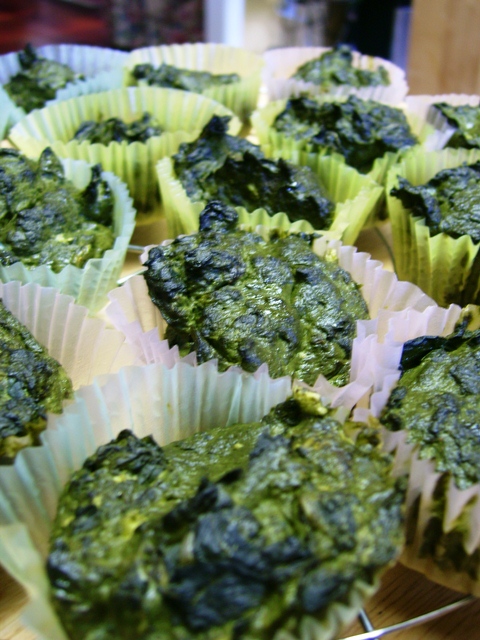
Green "Muffins" [Paleo][Low Carb]

Want a healthy Halloween appetizer, snack, or just a plain old hearty munchie? Try some ghoulishly green muffins (don't fret they're just spinach egg muffins).  I was trying to find a good Cindalou option for a Halloween party dish and Jon suggested that I just make some of my normal food- something gross looking and green goo-ish.  For once we agree ;)


I adapted this recipe from Steal This Meal Spinach Egg Muffins, though I have made similar in the past with coconut flour.  This time I added egg whites (since I had them) and used my Vitamix (since I'm lazy).  Steal this meal also has a nice kale recipe for those kale fans out there... that's me, of course.   They have a great Paleo recipe and lifestyle site so check it out.  No, I don't know them I just like their stuff.  Not everyday you can mash the superfood vitamin and mineral packed bags o' spinach and farm fresh free range eggs into a Paleo party bite.  Well, around here it is an everyday thing...  You can almost sing the alphabet in vitamins in this dish- give me a "A," "K," "MaGNESIUM."  Not to mention bioavilable B12, choline, selenium.  You get the idea.  Alas, onto green goodness:

Ingredients:

6 whole fresh eggs
1/4 c. dried egg whites (or 6 egg white equivalent or just more eggs) + water (see below)
3 cloves raw garlic
3 lbs. frozen spinach
1 T. lemon juice (optional)
sea salt and pepper, to taste (about 2 t.-1 T. each)
spices to taste: I used ~1 T. crushed red pepper, Italian seasoning, and 1 t. cayenne)
2 T. extra virgin olive oil
    Preparation
    Steam the 3 lbs frozen spinach with 1 T. water and 1 T. lemon juice (if desired) until vibrant green but soft and cooked (7-10 mins depending on temperature). Set aside and let cool. 

    Line muffin cups and spray with nonstick spray or coat with coconut oil (or real butter). Preheat oven to 350 degrees. 

    In the Vitamix (or your blender) add the powdered egg whites (I used 1/4 c. dry egg whites= 6 egg whites of the Deb El Just Whites brand) and water (1/2 c. then additional 1/4 c water to make smooth consistency) and blend on low until dissolved (1-2 minutes, varying speed). 


    Using a jam press or slotted spoon drain the spinach until very dry. I also used my flat fold colander to help squeeze out all the liquid, though hands work fine also. 

    Add the spinach to the egg white-water mixture in blender. Blend on medium for 1 minute to help mix. Add 6 raw eggs. Add garlic and spices (also pepper, 1 T. Italian seasoning and 1 T. crushed red pepper) and extra virgin olive oil. 


    Blend on medium mixing with Vitamix damper. When well mixed (2-3 minutes) turn to high and mix vigorously until well blended and bright green (my favorite!) Spoon into muffin cups and bake at 350 for 15-17 minutes or until toothpick comes out clean.


    Best toppings (as if they need 'em): raw organic almond butter or coconut oil (butter for ya'll dairy folks out there).  Actually a kalamata olive would go nicely too...

    Yield: About 22 medium "muffins" (I swae that count is before I ate half the batch!)
    I added this recipe to Nutrition Data for the stats and label: 


    Army of green goblin goodness... ahh yum!


    Cindalou's Kitchen Blues: Healthy Celiac / Coeliac Gluten and Dairy Free Recipes